Simulating molecular adsorbates
Molecular moves exchange whole molecules such as CO, O2, or H2O with the reservoir instead of single atoms. Read this page when your adsorbate is a molecule, when you need to set a molecular chemical potential, or when atomic and molecular species share one simulation.
How it works
Molecules move as rigid bodies. The insertion proposal places the template at a random position with a uniform random orientation, and the displacement proposal translates and rotates a molecule without bending it. With a relaxing calculator the molecule still relaxes after placement, so the rigid template is a starting point, not a frozen geometry.
mu means the full molecular chemical potential.
Orientations are proposed uniformly, which absorbs the rotational partition
function into the chemical potential rather than into the acceptance rule.
Compute the molecule’s energy in a box with your production calculator and
pass mu = E(molecule) + delta_mu, where delta_mu carries the
translational, rotational, and pressure contributions of the reference
reservoir.
Acceptance counts molecules of the exchanged species. The combinatorial \(N\) in the insertion and deletion rules is the number of molecules of that species with center of mass inside the move’s cell, and the de Broglie wavelength comes from the total molecular mass. This is the textbook rigid-molecule convention. Atomic moves keep mcpy’s historical total-atom-count convention, and the two coexist in one run. GCMC acceptance: the de Broglie particle count records why the conventions differ.
A per-atom molecule_id array tracks membership.
Every atom carries an integer id, with members of one molecule sharing a
value and free atoms carrying -1.
Deletion removes a whole id group, and the array shrinks with the structure,
so membership never drifts out of sync with the atom list.
Rollback restores the bookkeeping.
The ensembles restore all per-atom arrays when a trial is rejected, and
molecule_id is such an array, so a rejected molecular trial leaves the
bookkeeping bit-identical to before the proposal.
Trajectories carry molecule_id for restarts.
The extended-XYZ writer declares the array in Properties=, so
ase.io.read recovers it.
A molecular run restarted from its own trajectory resumes with intact
molecule membership instead of a heap of anonymous atoms.
Atomic and molecular species can coexist. An atomic insertion tags its new atom as free explicitly, because ASE’s array extension would otherwise zero-fill the id and silently attach the atom to molecule 0. An atomic deletion draws only from free atoms and never dismembers a molecule. This enables mixed reservoirs, for example dissociative O at half the O2 chemical potential alongside molecular O2. One caveat remains: the atomic displacement-type moves are not molecule-aware and can drag a single member atom, which a relaxing calculator tolerates but the rigid-molecule picture does not.
An optional angle cap tames the rotation proposal. A full uniform rotation is the correct default for a physisorbed molecule, but for a strongly anchored one it proposes flips the surface always rejects. Measured on CO on a CuPd nanoparticle, capping the angle raised displacement acceptance from 5 percent to 42 percent and roughly halved the steps to convergence. The capped proposal stays symmetric, so no acceptance correction is needed.
BatchedReplicaExchange is the replica-exchange path.
The MPI ReplicaExchange counts species by chemical symbol, which is
always zero for a molecular name, so its constructor raises
NotImplementedError rather than silently accepting every swap.
The batched variant counts molecules in its grand-potential bookkeeping and
is the supported way to run molecular ladders.
API walkthrough
Registering a molecular species
GrandCanonicalEnsemble(..., mu={'CO': e_co - 0.65}, molecules={'CO': co_template}, species=[])The
moleculesdict maps each species name to its ASE template. The name is the key you use inmuand pass to the molecular moves, and it must not collide with an element symbol already present as an atomic species. Leavespeciesempty when every exchanged species is molecular.SetUnits(unit_type, temperature, species, molecules=None)Computes the per-species de Broglie wavelengths, using the total molecular mass for molecular entries. Built automatically by the ensemble. It rejects two templates with identical compositions, because the id-based bookkeeping cannot tell isomers apart.
Exchanging molecules with the reservoir
MoleculeInsertionMove(cell, molecule, name, seed, min_insert=None, max_molecules=None)Inserts the template rigidly at a random position and orientation drawn from the cell. The template is centered on its center of mass at construction, and the whole molecule is appended in one step with a fresh
molecule_id.min_insertretries the draw until every new atom clears that distance from the existing structure, which spares the calculator from evaluating hopeless overlaps.max_moleculesskips the trial once the population reaches a cap.MoleculeDeletionMove(cell, molecule, name, seed, min_molecules=None)Deletes one molecule of the species, drawn uniformly among those whose center of mass lies inside the cell. Reports a failed proposal when no candidate exists or when
min_moleculeswould be violated, and failed proposals stay out of the acceptance statistics.
Moving adsorbed molecules between sites
MoleculeDisplacementMove(cell, molecule, name, seed, max_displacement=0.5, max_angle=None)Translates one molecule’s center of mass by a random vector inside a sphere of radius
max_displacement, then rotates it about the displaced center. Both parts are symmetric proposals, so the move runs under the plain Metropolis rule. A displacement that would carry the center of mass out of the cell is rejected, because a molecule outside the region would silently leave the grand-canonical bookkeeping. Setmax_angle(radians) for anchored adsorbates such as CO, and leave the full rotation for physisorbed ones.
Inspecting molecules in a configuration
find_molecules(atoms, template_symbols, cell=None)Returns the member-index groups of every molecule matching the template composition, optionally filtered to centers of mass inside a cell. Useful for counting coverage per frame when post-processing a trajectory.
molecule_com(atoms, members)Returns the center of mass of one member group.
random_rotation_matrix(rng)Draws a rotation uniformly over orientations, the same generator the insertion and displacement proposals use.
Worked examples
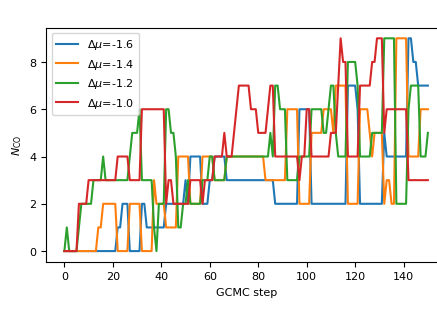
Molecular GCMC in motion: \(N_{\mathrm{CO}}\) on a CuPd nanoparticle against GCMC step, one trace per \(\Delta\mu\) rung of a batched replica-exchange ladder (from the executed CO/CuPd notebook). More CO-rich conditions settle at higher coverage.
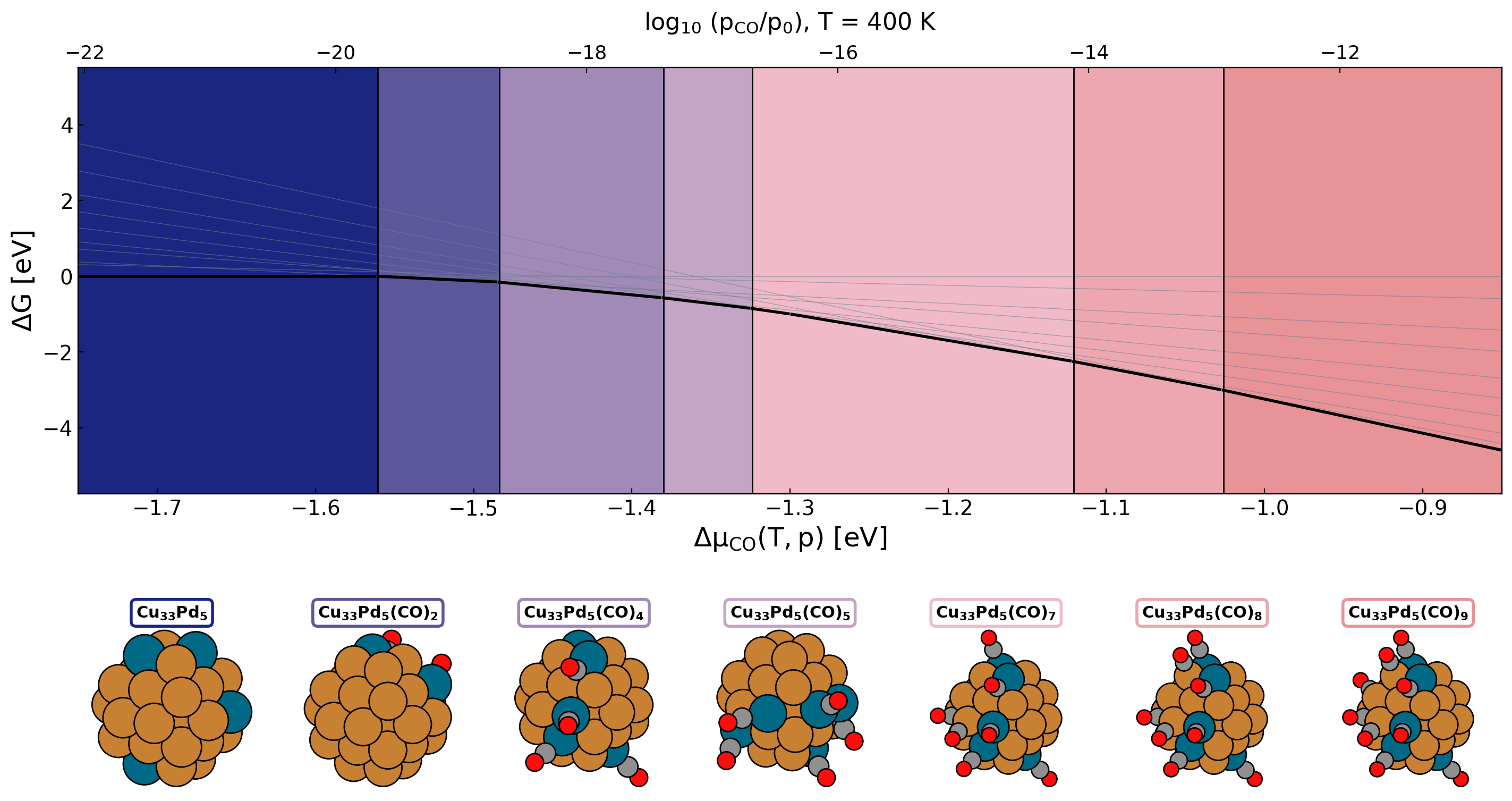
The resulting phase diagram: stable (CO)n phases of the Cu33Pd5 particle against the CO chemical potential (see Building phase diagrams from GCMC output).
examples/gcmc_molecule_mace.pyadsorbs any ASE-buildable molecule on Ag(111) with MACE.examples/re_gcmc_co_cupd_batched.pyruns CO on a CuPd nanoparticle across a mu ladder with batched replica exchange.The molecular GCMC notebook walks the machinery step by step with executed output (see Notebooks).